 AgelessCore

Most people who return to exercise after a long absence, or begin for the first time somewhere past their fortieth birthday, overestimate how much equipment they need and underestimate how much their own body weight can do. A chair, a wall, a few feet of floor space and some patience are sufficient for the first several months of a sensible strength programme. The appeal of bodyweight training at this stage of life has less to do with convenience, though that matters, and more to do with the fact that it forces a person to relearn basic movement patterns before loading them with anything external.
This article sets out a practical starting point: the four movement categories worth mastering, a weekly structure that will not collapse under the pressure of a busy life, signs that indicate it is time to add difficulty, the mistakes that show up most often in people over 40, and a reasonable path toward added resistance once the basics are secure. None of this requires athletic background. It requires consistency and a willingness to move slightly slower than the instinct to rush suggests.
Why Bodyweight Training Suits a Starting Point
Joint tissue, tendon elasticity and balance reflexes all change gradually with age, and the changes are rarely dramatic enough to notice day to day until a sudden movement, an awkward step off a curb, or a heavy suitcase exposes a weakness that had been building quietly. Bodyweight exercises load the body in a way that is proportional and self-limiting: a person cannot easily hurt themselves doing a wall push-up the way they might with a loaded barbell performed with poor technique, because the resistance is capped at whatever fraction of body weight the exercise variation demands.
There is also a coordination argument. A squat, a hinge, a push and a pull are patterns the body already knows from daily life, getting out of a chair, picking something off the floor, pushing open a heavy door, pulling a drawer. Practising these patterns without added load allows the nervous system to groove the movement correctly before strength becomes the limiting factor. Adding a barbell or a set of dumbbells to a faulty pattern simply makes the fault more forceful and more likely to cause strain.
A further practical point: bodyweight training over 40 allows for daily small-dose practice without the fatigue cost of external loading. Five minutes of sit-to-stand practice on a day off from the main programme does not interfere with recovery the way an extra set of loaded squats might. This flexibility matters more for someone managing a job, family obligations and inconsistent sleep than it does for a twenty-five-year-old with recovery capacity to spare.
Core Movements: Squat, Hinge, Push, Pull
Four patterns cover most of what a beginner needs for the first three to six months. Each has an entry-level variation and a slightly harder one, and progress within bodyweight training mostly means moving along that ladder rather than adding weight.
- Squat: begin with a sit-to-stand from a chair, hands free or lightly touching the seat for balance, 2 to 3 sets of 8 to 12 repetitions. Once that feels unremarkable, move to a bodyweight squat without the chair, then to a slower tempo squat (3 seconds down, 1 second pause, 2 seconds up).
- Hinge: a hip hinge pattern, practised first against a wall or with hands sliding down the thighs, teaches the body to bend at the hips rather than the lower back. A beginner variation is the standing hip hinge with a dowel or broomstick held along the spine to check alignment, 2 sets of 10.
- Push: wall push-ups first, then incline push-ups against a sturdy table or bench, then floor push-ups from the knees before full push-ups. Each step should feel comfortably doable for 8 to 10 repetitions before advancing.
- Pull: pulling is the hardest pattern to train without equipment, since there is no bodyweight row without something to pull against. A sturdy table edge, a low bar, or resistance bands anchored to a door can substitute. Where no equipment at all is available, prone "Superman" holds and scapular squeezes offer a partial substitute until a resistance band or suspension strap becomes available.
A reasonable first session combines one exercise from each category, roughly 20 to 30 minutes including rest between sets. The goal in the opening weeks is not fatigue but competence: a person should finish the session feeling capable of doing it again the next day, not depleted.
Setting a Realistic Weekly Schedule
Three sessions a week, non-consecutive days, is a workable frequency for most beginners over 40. This allows 48 hours of recovery between full-body sessions, which matters more at this stage of life because connective tissue tends to adapt more slowly than muscle itself, even when muscle soreness has already faded.
| Day | Focus | Approximate time |
|---|---|---|
| Monday | Full-body: squat, push, pull variation, short walk | 30 to 40 minutes |
| Tuesday | Rest or light walking | optional |
| Wednesday | Full-body: hinge, push, pull variation, balance drill | 30 to 40 minutes |
| Thursday | Rest or light walking | optional |
| Friday | Full-body: squat, hinge, push, pull, mobility work | 35 to 45 minutes |
| Weekend | Rest, recreational activity, or a short repeat session | optional |
This schedule is deliberately conservative. Someone who misses a session should simply resume on the next scheduled day rather than attempting to compress two sessions into one, since doubling up tends to produce the kind of fatigue that discourages a fourth week. Consistency over eight to twelve weeks matters considerably more than the intensity of any single workout.
For those managing joint discomfort, a mild chronic condition, or returning after a long period of inactivity, a conversation with a physician or physical therapist before beginning is a reasonable precaution rather than an excessive one, particularly if there is a history of back pain, knee surgery, or cardiovascular concerns.
How to Judge When to Progress
The most common error at this point is progressing by calendar rather than by competence. A fixed rule, such as adding difficulty every two weeks regardless of how the exercise feels, ignores the fact that adaptation rates vary considerably between individuals and between the four movement patterns themselves.
A more reliable marker is repetition quality across two consecutive sessions. If a person can complete 3 sets of 12 repetitions of an exercise with controlled form, no compensatory movement, and the sensation that one or two more repetitions were available, that is the signal to move to the next variation rather than simply adding more repetitions of the same movement. Conversely, if form degrades noticeably after the eighth repetition, more practice at the current level is the better use of time.
A simple log, even a basic one noting date, exercise, sets, repetitions and a brief note on how it felt, removes the guesswork. Over six to eight weeks, the pattern in that log, steady improvement, a plateau, or a fluctuation tied to sleep or stress, tells a more accurate story than memory alone.
Common Form Mistakes to Watch For
Certain errors recur often enough in beginners over 40 to deserve specific attention, partly because they tend to go unnoticed without external feedback such as a mirror, a training partner, or a recorded video.
- Letting the knees collapse inward during a squat, which places uneven stress on the knee ligaments. Cueing the knees to track roughly over the toes, and widening the stance slightly, usually corrects this.
- Rounding the lower back during a hip hinge instead of bending at the hips. Practising with a dowel along the spine, as mentioned above, gives immediate feedback if the lower back rounds.
- Flaring the elbows out to 90 degrees during push-ups, which places unnecessary strain on the shoulder joint. Keeping the elbows closer to a 45 degree angle from the torso tends to be more comfortable for most shoulders.
- Holding the breath during effort, a habit sometimes called the Valsalva manoeuvre when exaggerated, which can spike blood pressure briefly. Exhaling during the effort phase of each repetition, inhaling during the easier return phase, is a simpler default for beginners.
- Rushing through repetitions to finish the set rather than controlling the tempo, which reduces both safety and the training benefit of the movement.
Anyone with persistent joint pain, sharp pain rather than mild muscular fatigue, or symptoms such as dizziness or chest discomfort during exercise should stop the session and seek medical evaluation rather than attempting to adjust technique on their own.
Building Toward Added Resistance Later
After roughly three to six months of consistent bodyweight training, most beginners reach a point where the hardest bodyweight variation of a given exercise, say a full push-up for 3 sets of 15, or a single-leg assisted squat, no longer presents much challenge. This is the natural point to introduce external resistance, not before.
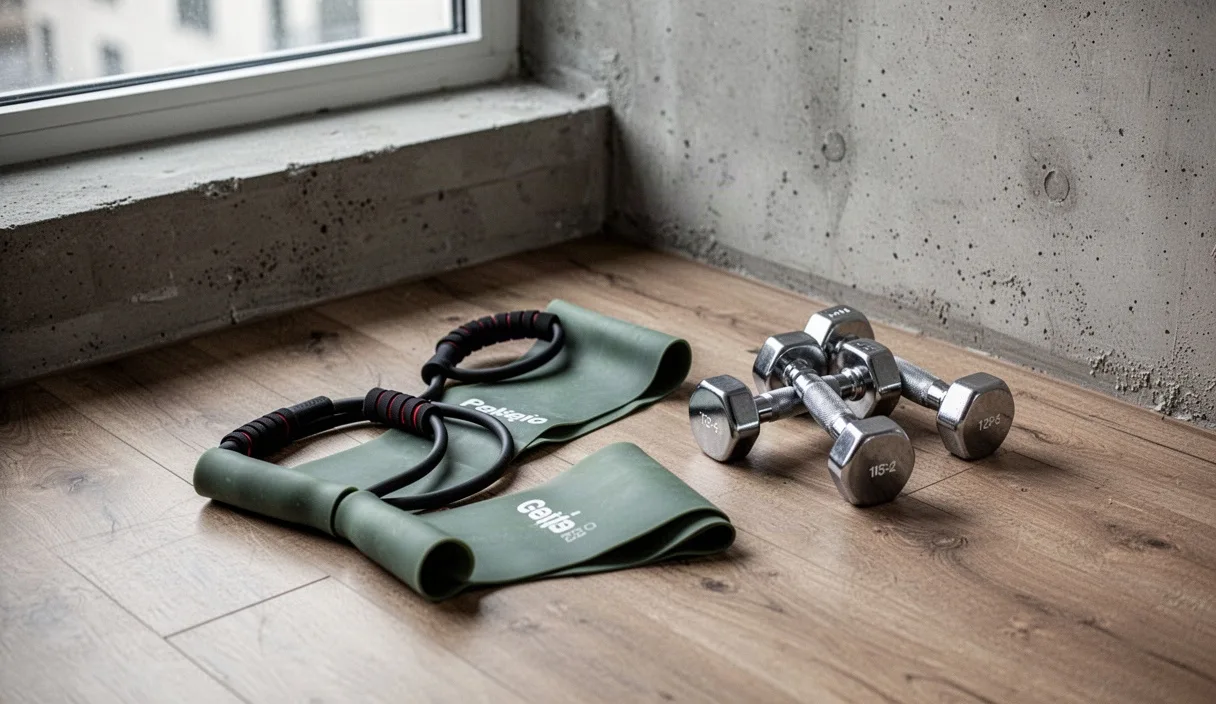
Resistance bands are usually the gentlest bridge, since they allow fine adjustments in load and can be used for rows, presses and assisted squats alike. A set of adjustable dumbbells, or a pair of fixed-weight dumbbells in the 5 to 15 pound range, is a reasonable next step for someone who has outgrown band resistance for upper body pulling and pushing work. Kettlebells suit the hinge pattern particularly well once the bodyweight hinge is well established, since the kettlebell swing reinforces hip drive rather than lower back extension, provided the technique is learned correctly, ideally with at least one session of in-person coaching to confirm the movement before training it unsupervised.
The transition does not need to happen all at once across every movement pattern. A practical approach is to add resistance to one pattern, commonly the pull, since bodyweight pulling options are limited, while continuing bodyweight progressions for the other three until each individually reaches its ceiling. This staggered approach keeps the overall training load manageable and avoids the common mistake of introducing four new skills and four new loads in the same week.
Next Steps
A sensible starting point is two weeks of the four core patterns at their easiest variation, performed three times weekly, with a simple log kept for each session. At the end of that period, review the log honestly: where form held up and repetitions felt controlled, move to the next variation; where it did not, stay put for another two weeks rather than forcing progress.
Anyone with existing joint conditions, cardiovascular concerns, or uncertainty about a particular movement should arrange a session with a physical therapist or a qualified trainer experienced in working with adults over 40, both to confirm technique and to rule out any movement that should be modified or avoided given individual history. Beyond that, the work itself is unglamorous and repetitive by design, which is, in this case, precisely the point.