 AgelessCore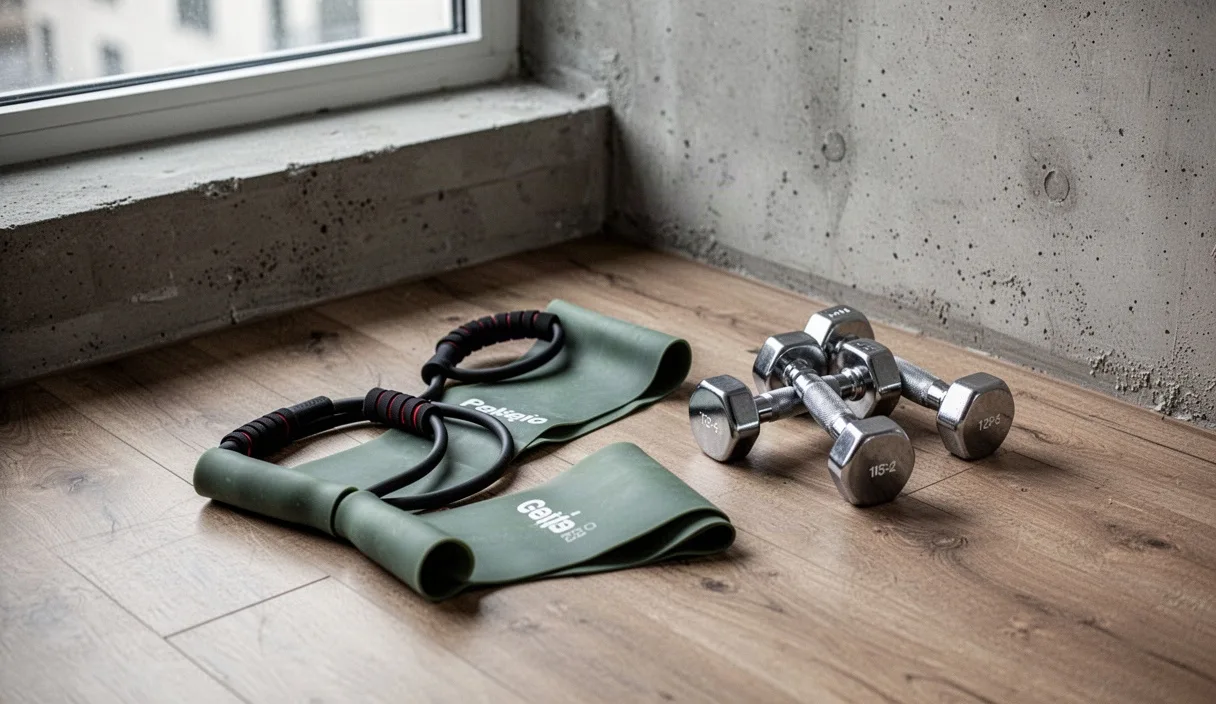

Somewhere around the fourth decade of serious training, most people start asking a version of the same question: should the bulk of my strength work come from a rack of dumbbells or a bag of elastic bands? The question tends to surface after a cranky shoulder, a tender knee, or simply a growing suspicion that barbell squats are no longer the unambiguous good they once seemed. There is no single correct answer, but there is a defensible way to think through the trade-offs, and that is what this article attempts.
Resistance bands and free weights are not competitors so much as tools with different mechanical signatures. Free weights load the body with a fixed mass that behaves according to gravity; bands load it with elastic tension that changes through the range of motion. For joints that have accumulated some mileage, that difference in loading curve matters more than most marketing copy admits. The sections below break down where each tool excels, how joint stress actually differs between them, and how to combine them sensibly rather than picking one and discarding the other.
What Each Tool Is Actually Good At
Free weights, meaning dumbbells, kettlebells, and barbells, apply a constant gravitational load regardless of where the joint is in its arc. A 20-pound dumbbell weighs 20 pounds whether the elbow is bent or straight. This makes free weights reliable for building raw strength and for training movements that mimic real-world lifting, where objects do not become lighter as you pick them up. They are also the better tool for tracking progress in a straightforward way: adding 2.5 pounds to a dumbbell press is an unambiguous measure of progression.
Bands, by contrast, apply resistance that increases as they stretch. A light band might offer almost no tension at the start of a row and considerable tension at the end. This variable curve is useful for two things aging lifters often need: reducing load at the most vulnerable joint angle, and accommodating the body's natural strength curve, which is usually weaker at full extension or full flexion and stronger in the middle. Bands are also far more forgiving of asymmetry, since each limb pulls its own band rather than sharing a fixed bar.
A practical example: someone with a sensitive lower back who wants to train hip hinge patterns can use a band-resisted deadlift pattern, where tension builds progressively rather than being maximal the instant the bar leaves the floor, as happens with a loaded barbell.
Joint Load: Bands Versus Free Weights
The term "joint-friendly" gets used loosely, so it helps to be specific about what changes between the two tools. With free weights, peak joint torque typically occurs at the bottom of a lift, for instance the deepest point of a squat or the stretched position of a biceps curl, precisely where tendons and cartilage are least mechanically advantaged. With bands, the lowest tension often coincides with that same vulnerable position, because the band is least stretched there, and tension climbs as the joint moves into a stronger, more stable range.
This does not mean bands are universally gentler. A band anchored awkwardly, or one that is too strong for the available range of motion, can generate a sudden tension spike at end range that surprises a joint more than a dumbbell ever would. The quality of the loading curve depends on band selection and anchor point, not on the category "band" itself.
Compression load, the force pressing joint surfaces together, also differs. A goblet squat with a 15-kilogram dumbbell compresses the knee and hip joints with that mass plus the body's own weight. A band squat of equivalent perceived effort often produces less compressive load at the bottom of the squat, because the resistance is lower exactly where compression would otherwise peak.
A simple comparison for a 55-year-old with mild knee joint mobility working on seated leg extensions:
| Factor | Free Weight (ankle cuff) | Band |
|---|---|---|
| Peak load point | Full extension, often locked knee | Full extension, but load is user-adjustable by anchor distance |
| Load consistency | Fixed regardless of fatigue | Self-limits as form breaks down and tension drops off |
| Ease of micro-adjustment | Requires changing plates | Can shift anchor point mid-session |
Anyone with a diagnosed joint condition, a recent surgery, or persistent swelling should have a physical therapist or physician review the specific exercises and loading pattern before assuming either tool is automatically safer. General guidance about loading curves is not a substitute for an individual assessment.
Cost and Space Considerations
A full set of adjustable dumbbells covering 5 to 50 pounds per hand, plus a bench, commonly runs 300 to 600 dollars depending on brand and whether the plates are rubber-coated or cast iron. A squat rack and barbell setup capable of meaningful progressive overload adds another 400 to 900 dollars and requires a dedicated floor area of at least 6 by 8 feet, more if safety bars or a cage are involved.
A set of five to seven resistance bands covering light to heavy tension, including a door anchor and ankle straps, typically costs between 40 and 90 dollars and stores in a drawer or a small bag. For anyone training in an apartment, a hotel room during travel, or a shared space, this difference is not trivial.
The counterargument is durability and ceiling of load. Latex bands degrade with UV exposure and repeated stretching, usually needing replacement every 8 to 18 months with regular use, whereas cast iron dumbbells last decades. Bands also have a practical strength ceiling: once someone needs more than roughly 150 pounds of resistance at full stretch for a compound movement, stacking multiple heavy bands becomes unwieldy compared with simply loading more plates.
Which Tool Suits Which Training Goal
Matching the tool to the goal avoids a lot of unnecessary debate. Below is a working breakdown based on common objectives among people training through their fifties, sixties, and beyond.
- Building or preserving bone density: free weights generally win here, since the research on osteogenic loading (work by Bhattacharya and colleagues and others) has focused mostly on axial loading from barbells and weighted carries, where the load is substantial and gravity-driven.
- Rehabilitating a joint after injury or surgery: bands usually come first, under the guidance of a physical therapist, because the ramping tension allows controlled, pain-contingent loading that is harder to replicate with fixed weight increments.
- Improving shoulder stability and rotator cuff endurance: bands are often preferred for external and internal rotation work, since the light, constant tension at various angles suits the small stabilizing muscles better than a heavy dumbbell would.
- Maximal strength development: free weights remain the standard, since the ability to quantify and progressively increase an external load in small, exact increments is difficult to match with elastic resistance.
- Travel-friendly maintenance training: bands are the clear practical choice, fitting in carry-on luggage and requiring no floor space.
Balance and proprioception training sits in a gray area. Free weights held unilaterally, such as a single dumbbell carried at the side, challenge balance through asymmetric loading. Bands anchored at odd angles challenge balance through directional pull. Both have a place, and alternating between them likely offers more carryover to daily movement than relying on either exclusively.
Combining Both in a Weekly Plan
Most people training for long-term joint health do not need to choose one tool permanently; a week built around both tends to cover more ground than either alone. A sample structure for someone training three days a week:
- Day one, free weight emphasis: goblet squats, dumbbell rows, and standing presses for 3 sets of 8 to 10 repetitions, prioritizing controlled tempo over heavy loading.
- Day two, band emphasis: band-resisted rotator cuff work, lateral band walks for hip stability, and band pull-aparts for upper back endurance, typically 2 to 3 sets of 12 to 15 repetitions.
- Day three, combined session: a dumbbell deadlift pattern followed by band-assisted hamstring curls or band-resisted step-ups, pairing a strength-focused movement with a joint-friendly accessory.
This structure lets the heavier, bone-loading work happen when a joint is fresh and recovered, while the band work targets smaller stabilizing muscles that benefit from frequent, lighter stimulation rather than maximal effort. Someone managing a cranky shoulder, for instance, might do dumbbell work for the lower body and bands for all upper body pressing and pulling until the shoulder settles, then reintroduce light dumbbell pressing gradually.
When to Favor One Over the Other
There are situations where the choice tips clearly in one direction rather than remaining a matter of preference.
Favor bands when a joint is newly symptomatic, swollen, or recovering from a flare-up, when training away from home, when working on end-range stability for a shoulder or ankle, or when someone is returning to exercise after a long layoff and needs a lower barrier to entry. Favor free weights when the goal is measurable strength progression over months, when bone density is a specific concern flagged by a physician following a DEXA scan, or when training compound lower-body patterns that require more total load than bands can comfortably provide.
Anyone with cellular vitality, a joint replacement, or a cardiovascular condition should discuss both tools with a physician or physical therapist before building a program, since the right answer often depends on specifics that a general article cannot account for, such as the exact location of a healed fracture or the stability of a replaced joint.
Common Mistakes
A few recurring errors show up regardless of which tool someone chooses. Using a band that is far too strong for the exercise, which turns a controlled movement into a jerky one at end range. Anchoring a band at a height that creates an awkward pulling angle, increasing shear force on the shoulder or knee. Assuming dumbbell weight equals safety simply because it is lighter than a barbell, when poor form at any load can still irritate a joint. And neglecting to replace worn bands, which can snap unpredictably once the latex shows visible cracking or discoloration.
Practical Next Steps
Start by inventorying what a current joint complaint, if any, actually responds to: if a shoulder feels worse under fixed dumbbell load but tolerates band work through a full range, that is useful information worth building a plan around. Buy a modest set of three to five bands in varying tension before investing heavily in free weights, since bands are cheap enough to experiment with and will clarify which movements feel genuinely comfortable. Keep a simple log noting which tool and which range of motion produced any joint discomfort, and bring that log to a physical therapist or sports medicine physician if symptoms persist beyond two or three weeks. Reassess the plan every six to eight weeks rather than assuming the first setup chosen is permanent, since joints, like training goals, tend to change over time.